
When Andrea Price was invited to compose a new work for the National Youth Brass Band of Great Britain, she knew it would be no ordinary commission.
The result is ‘Victoria Wood: A Laugh Less Ordinary’ - a celebration as well as deeply personal tribute that seeks to capture not just the comedian’s distinctive humour, but also her humanity almost a decade after her death.
“It’s always a privilege to receive a commission,” Andrea says of the work funded by the Victoria Wood Foundation.
“There are so many wonderful composers out there, so to be trusted with something like this, especially connected to her name and legacy is incredibly special.”
Weight of responsibility
She also readily acknowledges that the privilege came a certain weight of responsibility. Wood is widely celebrated as a comedian, writer and performer, but as Andrea quickly discovered, her musical voice runs just as deep.
“When you really start to look beneath the surface, you realise what a phenomenal composer she was. Her music seems deliberately simple because it exists to serve the lyrics, so separating it was one of the biggest creative challenges.”
Essence
However, rather than create a medley of familiar tunes, Andrea sought something more meaningful with a structure reflecting the essence of Victoria Wood as a person.
“The idea of a medley came up early on, but that can feel quite superficial,” she explained.
“What really struck me as I researched her life and work, was that everything she did was rooted in human connection; friendship, relationships, the way people interact. That became the foundation.”
“What really struck me as I researched her life and work, was that everything she did was rooted in human connection; friendship, relationships, the way people interact. That became the foundation.”
Ethos
It’s a theme that resonates strongly with the ethos of the NYBBGB itself, where lifelong friendships are often forged. “That felt like such a natural link. The idea that music brings people together - just as her work did.”
Central to this was Wood’s enduring creative partnership with actor Julie Walters. Their friendship becomes a recurring thread, reflected musically through dialogue between instruments - most notably cornet and euphonium representing two distinct but intertwined voices.

The composer acknowledges that the privilege of writing the work to celebrate Victoria Wood
From Sitcom to Symphonic Scale
The piece opens with a dazzling reimagining of the ‘Dinnerladies’ sit-com theme, transformed into “an all-singing, all-dancing fanfare” as Andrea explains.
“That theme is such a perfect example of her genius - taking something completely ordinary and turning it into something extraordinary. A sitcom about dinner ladies shouldn’t be iconic, and yet it is. I wanted to celebrate that by giving it a sense of scale and glamour, putting it on a pedestal in a way she probably never would herself.”
From there, the music shifts dramatically in tone. A virtuosic solo cornet cadenza introduces a more introspective personal portrait - one that reflects her well-documented self-doubt and stage fright.
A virtuosic solo cornet cadenza introduces a more introspective personal portrait - one that reflects her well-documented self-doubt and stage fright.
“I imagine her backstage, pacing, giving herself a talking-to before going on,” Andrea explains. “The cadenza is deliberately exposed and technically demanding. It creates a sense of tension, not just for the audience, but for the performer too. It’s a reminder that even someone as brilliant as her felt nervous. That’s something every performer can relate to.”
That sees the cornet’s musical ‘voice’ echoed by a muted trombone - a conversation or perhaps a reflection in the mirror as Andrea says: “It’s that moment of asking yourself, ‘Can I do this?’ and finding the courage to step forward.”
Reimagining the Music
Her song ‘Reincarnation’ is then used as a springboard for a whirlwind of styles - from operatic to New Orleans jazz and a high-energy march.
“The band is an elite group, Andrea says, “so they need to be challenged. It was important to create something that pushed them technically while still being engaging and fun.”
“The challenge with a song like that is that it’s very verse-based,” Andrea says. “Without lyrics, repeating the same music doesn’t work in the same way. So, I started thinking about the idea of reincarnation itself - of something returning in different forms - and used that to explore a range of musical styles.”
This approach reflects Wood’s playful creativity but also showcases the versatility of the ensemble. “The band is an elite group, Andrea says, “so they need to be challenged. It was important to create something that pushed them technically while still being engaging and fun.”
Friendship, Loss and Legacy
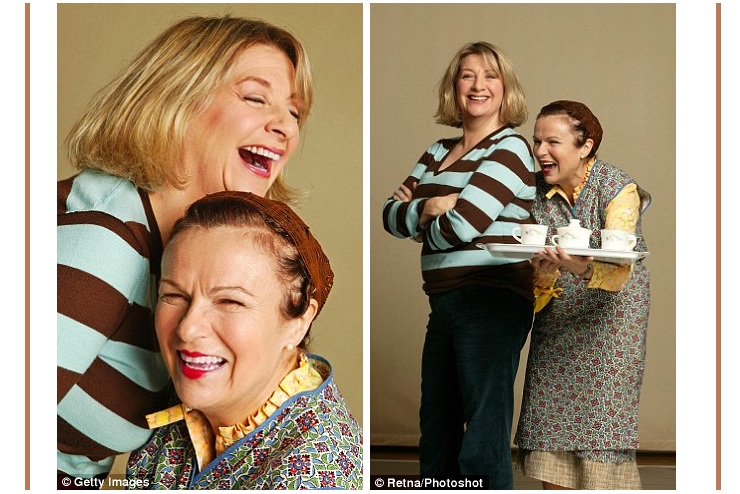
The work’s emotional core lies in an exploration of friendship, artistic partnership and loss, as musical ideas associated with Wood and Walters (above) intertwine before giving way to the inclusion of Bach’s ‘Fugue No. 2 in C minor’.
For Andrea, this moment operates on multiple levels. “That fugue is famously used in ‘Acorn Antiques: The Musical!’ to signal the arrival of Mrs Overall, Julie Walters’ wonderfully eccentric character,” she explains. “So, it immediately brings Julie into the musical narrative in a recognisable way. But beyond that, it became such a powerful metaphor.”
Weave around
The fugue is built on independent musical lines that weave around each other; sometimes moving apart, sometimes coming back together. For Andrea, this perfectly mirrored Victoria and Julie’s lives and careers - one moving into film and theatre, the other remaining rooted in writing and television. The connection was never ever broken though.
For Andrea, this perfectly mirrored Victoria and Julie’s lives and careers - one moving into film and theatre, the other remaining rooted in writing and television. The connection was never ever broken though.
“You can imagine them crossing paths, then going off in completely different directions, then meeting again. That’s exactly what a fugue does.”
Deeper layer
Andrea adds that there is also a deeper layer of homage. “Bach was a master of his craft, and his ability to shape and manipulate music is extraordinary. And in her own way, Victoria was exactly the same. So, including that fugue felt like one artist quietly acknowledging another.”
As it develops, the music intensifies before breaking into a moment of emotional clarity. “There’s a point, almost exactly halfway through the piece, where everything changes,” Andrea says. “It reflects the fact that Victoria was taken from us far too soon. There’s a real sense of loss - of what might have been.”
“It reflects the fact that Victoria was taken from us far too soon. There’s a real sense of loss - of what might have been.”
Love Song
The lyrical reimagining of ‘Love Song’, led by the euphonium that follows is a subtle creative liberty, imagining the voice not as Victoria herself, but as a response to her passing.
“It becomes less about the original context of the song and more about grief and remembrance,” she says. “It’s about those small, everyday details that suddenly carry so much emotional weight when someone is gone. That was something Victoria captured so beautifully in her writing.”
A Celebration in Brass
The work concludes with a triumphant finale inspired by her much-loved ‘Brassed Up’ sketch.
“It was such a joy to discover that sketch,” Andrea says. “You can see how much she loved the music, and she is genuinely played the cornet. That connection felt really important to include.”
Victoria’s work continues to inspire people, and it will do for generations to come.
It builds from a simple, hymn-like idea into a full, celebratory climax - an affirmation of Victoria Wood’s enduring legacy. “I wanted it to feel uplifting,” Andrea explains. “To look forward as well as back. Victoria’s work continues to inspire people, and it will do for generations to come.”
Writing for the Next Generation
Although composing for young musicians brought its own set of rewards and responsibilities Andrea sees projects like this not just as performances, but as moments that can shape a musician’s journey.
“Working with these talented players is incredibly inspiring,” she says. “They bring energy, curiosity and a willingness to take risks that keeps the music alive in a very immediate way. Creating a piece for them isn’t just about the notes on the page - it’s about opening a space for creativity, imagination and discovery.”
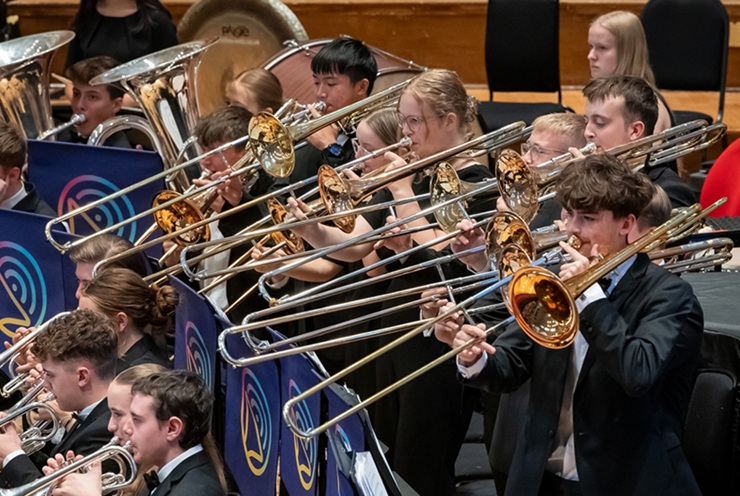
Andrea also hopes it will also introduce Victoria’s work to a new generation.
“These performers might be encountering Victoria’s humour, warmth and musical ideas for the first time,” she explains. “Through playing the piece, they connect with her storytelling in a direct, hands-on way. It’s a chance for them to experience the cleverness, sensitivity and joy that are so central to her work, and to carry that inspiration forward in their own musical lives.”
I hope the piece captures that sense of connection - between people, between generations, and between music and memory
A Lasting Tribute
After months of research, reflection and composition, Andrea hopes that ‘Victoria Wood: A Laugh Less Ordinary’ will resonate on multiple levels.
“I hope audiences recognise moments they know and love but also discover something new. And more than anything, I hope the piece captures that sense of connection - between people, between generations, and between music and memory.”
It is a work that offers not just laughter, but something deeper: a reminder of the extraordinary beauty found in the everyday, and of the enduring power of human connection.
Simon Watts