
When bands compete against each other, we like to think the best performance always wins.
Even when we strictly control for whether a band is a top-tier contender (a favourite with a realistic chance to win, which I have defined as a band ending up in the top 3), it appears that the random luck of drawing a late contest performance slot gives bands a major, unfair advantage.
However, after analysing 2,988 band performances across 145 separate contest events, the data actually proves that there is a hidden factor influencing the results: The order in which the bands play.
I have looked at the Swiss National Championships from 2004 to 2025, the European Championship from 1982 to 2026, the National Championship of Great Britain from 1976 to 2025, and the British Open from 1992 to 2025.
To underpin the research, I have looked at the Swiss National Championships from 2004 to 2025, the European Championship from 1982 to 2026, the National Championship of Great Britain from 1976 to 2025, and the British Open from 1992 to 2025.
Methodology and approach
To make sure these findings were scientifically accurate, I used an advanced statistical technique called Panel Data Regression with Fixed Effects.
To ensure the comparability of the data between contests, I conducted several adjustments:
I normalized the scale (to make fair comparisons between contests with 9 participants vs 23). I also included the individual results on both the own choice and the test piece for relevant contests (vs the final result, in order to account for the effect of the draw).
Finally, I tested whether the potential advantage was linear or exponential (using a quadratic formula).
I then applied a regression formula (a mathematical tool to see if there is a relationship between two variables or a cause and an effect). It also allows to show how strong that relationship is and allows you to make predictions.
I then applied a regression formula. It also allows to show how strong that relationship is and allows you to make predictions.
Concretely, I applied the following regression formula to test the relationship between draw, favorite status (defined as a band ending in the top 3), and the final position. This equation allows me to measure the impact of the draw on the final result, controlling for whether the band is a top-tier one.
𝐹𝑖𝑛𝑎𝑙 𝑃𝑜𝑠𝑖𝑡𝑖𝑜𝑛 = 𝛽1(𝐷𝑟𝑎𝑤 𝑜𝑟der) + 𝛽2(𝐷𝑟𝑎𝑤 order)2 + 𝛽3(𝑇𝑜𝑝 3 favourite) + Event baseline
The advantage of later draws
The data shows a clear pattern: the later a band plays, the better their final score and ranking tend to be.
If you take two identical bands with the exact same skill level, forcing one to play absolute first and letting the other play absolute last changes their fate completely.
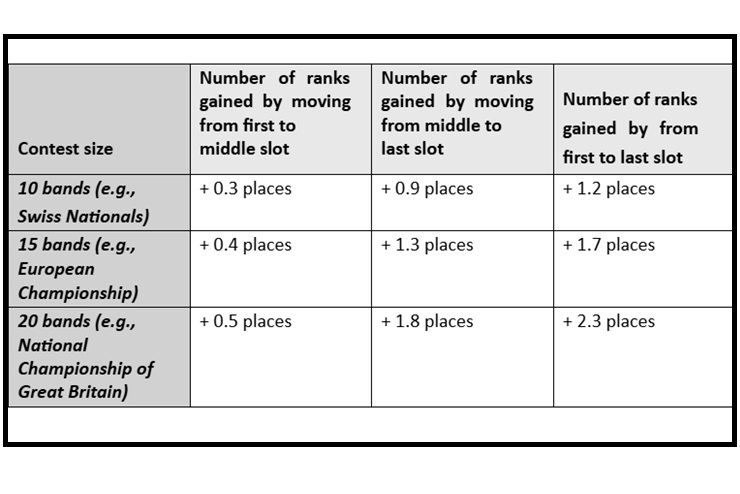
In a typical contest with 15 bands, the band playing last will automatically jump about 1.7 places higher on the leaderboard simply because of when they walked onto the stage.
In a typical contest with 15 bands, the band playing last will automatically jump about 1.7 places higher on the leaderboard simply because of when they walked onto the stage.
In a larger contest with 20 bands, that ‘luck-of-the-draw’ bonus increases to 2.3 places—which is easily enough to turn a 3rd-place finish into an outright victory.
Snowballs
The advantage of playing later doesn't build up evenly throughout the day. Instead, it behaves like a steep downward hill towards the podium.
The Middle-Slot Trap:
Moving from playing 1st to playing right in the middle of the day (e.g., slot 8 out of 15) barely helps at all. It only moves a band up by a tiny 0.4 places.
The Finale Boost:
The real magic happens at the very end. Moving from the middle slot to the absolute final slot of the day explodes into a 1.3-place boost.
Moving from the middle slot to the absolute final slot of the day explodes into a 1.3-place boost.
This happens, among other reasons, because judges suffer from what psychologists call recency bias. When a contest lasts for hours, judges naturally remember the final performances much more vividly and enthusiastically than the bands that played hours earlier.
Skill matters but luck is the tiebreaker
It still matters to be a favourite. The data shows that, unsurprisingly, bands flagged as favourites generally place about 5 places higher on the leaderboard than underdogs, regardless of when they play.
That is why, for a top-tier band, draw matters even more.
When skills are equal, the order of play becomes the ultimate tiebreaker. A fantastic band playing in the morning will likely lose to an equally fantastic band playing at the very end of the night – as demonstrated earlier, playing last increases the final results by 2.3 places!
When skills are equal, the order of play becomes the ultimate tiebreaker.
These results above hold true regardless of the size of the contest in terms of competing bands, whereas the effects are stronger the larger the contest size, as shown in the table below.
Now what?
This study shows that the current system of picking the playing order out of a hat is mathematically unfair. Because judges naturally reward the final acts fresh in their minds, drawing an early slot is a penalty, while drawing the final headline slot is a massive shortcut to the podium.
This is particularly relevant for a top-tier band.
This study shows that the current system of picking the playing order out of a hat is mathematically unfair.
We have recent examples of how this penalty plays out. Take 2025 European Champion Brass Band Willebroek, who, with a number 2 draw on the test piece at the 2026 European Championship, ended up ranking 8th on the test piece and 5th overall.
Or 2024 European Champions Brass Band Treize Etoiles, who, with two number 1 draws on both the test piece and their own choice piece at the 2025 European Championship, ended up ranking 4th and 6th respectively, and 6th overall.

One option to fix this mathematical unfairness would be, for example, to adopt what the organisers of the Swiss Open Contest have recently put into place: A band that draws in the first half in the morning (test piece), will automatically be drawn in the second half in the afternoon (own choice).
Of course, brass banding is for most of the banders of the world only a hobby. But when that hobby comes with dozens of hours of band and individual practice every week, I think it would only be fair to give everyone a fairer chance at the game.
Kathleen Gaspoz
Draw information provided by Brass Band Results
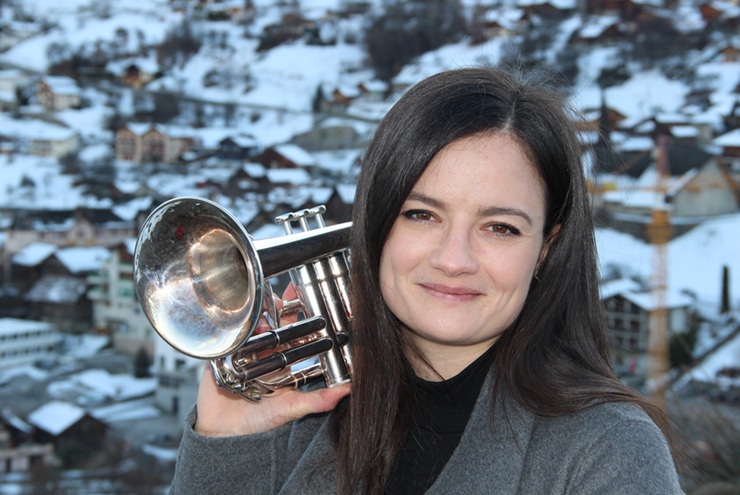
Kathleen Gaspoz is a Swiss cornet player, with extensive brass band experience in Switzerland and in the UK.
A founding member of the Valaisia Brass Band, she went on to play with Black Dyke Band and was the first woman to hold the principal cornet chair of Brighouse & Rastrick Band, with whom she won the 2017 National Championship of Great Britain, where she was awarded the ‘Best Soloist’ prize.
She holds a bachelor's degree in economics and a master's degree in finance from the University of St. Gallen, as well as a master's degree and a postgraduate diploma from the Royal Northern College of Music.
Kathleen is currently active in the Swiss banding movement and works as business strategist in the banking industry.