
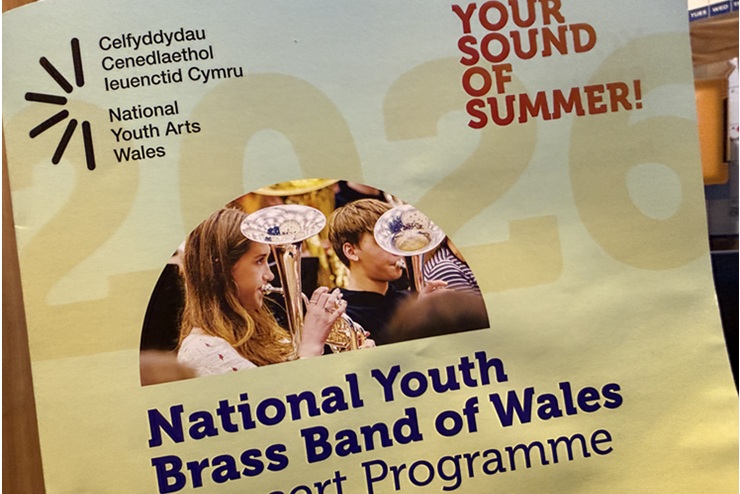
Conductor: Philip Harper
Soloist: Tom Hutchinson
Riverfront Theatre
Newport
Sunday 22nd August

At a time when a recent survey found that 34% of adults regretted giving up an interest in music, there has never been a more urgent need to promote the benefits that come with being a member of a flagship national arts ensemble.
Since 1982 successive generations of youngsters have experienced that with the National Youth Brass Band of Wales, yet its profile remains frustratingly under-developed in the consciousness of the nation’s listening public.
Its ethos remains current, its ambition admirable, but the advertising of it by National Youth Arts Wales is in desperate need of modernisation if it is to strengthen the wider appeal of its trio of annual concerts in the north, west and east of the country.
Listener friendly
This year they were led by Philip Harper – someone who certainly knows how to connect to audiences with listener friendly programmes. Here, three major works were balanced by energised concert pieces and an outstanding soloist. The result mixed endeavour with emerging musical maturity, the challenges set testing qualities without needlessly overextending them to breaking point.
His own works bookended things; ‘Anno 1920’ to open, the trio of ‘King Kong’ inspired cleverness to close. All that was missing was a Fay Wray scream in the ‘New York Rampage’ and Freddie Mercury hoovering the stage in ‘I Want to Break Free’.
All that was missing was a Fay Wray scream in the ‘New York Rampage’ and Freddie Mercury hoovering the stage in ‘I Want to Break Free’.
A Welsh tribute to composer Philip Sparke came with ‘A Celtic Suite’, whilst Swiss vibrancy came with Tom Davoren’s ‘Valaisia Variants’.
Considered Tomlinson
Guest soloist Tom Hutchinson showcased his talents in a considered account of the Ernest Tomlinson ‘Cornet Concerto’ that had a deliberately self-contained essence to its exuberant flashes as well as darkened reflections.
Tom Hutchinson showcased his talents in a considered account of the Ernest Tomlinson ‘Cornet Concerto’ that had a deliberately self-contained essence to its exuberant flashes as well as darkened reflections.
The playing of the tender ‘As I Pray’ and the waspish virtuosity of ‘The Litte Clover’ were equally endorsed with classiness.
Orbital stature
In-between came another opportunity to hear Richard Blackford’s ‘Orbital’, although it was a pity the composer was unable to enjoy it. Unlike one of International Space Station (ISS) astronauts contemplating life on earth at 17,000 miles an hour, unforseen travel delays meant he was he was left stuck on Swindon railway station.
Open and direct in its narrative communication, ‘Orbital’ has a deftness of compositional touch that echoes the page turning qualities of its source material
Open and direct in its narrative communication, ‘Orbital’ has a deftness of compositional touch that echoes the page turning qualities of its source material – the main solo lines played with confident bravura, the ensemble both thrusting and delicate. It’s a work that grows in stature by the performance.
Although the astronauts aboard the ISS enjoy 16 sunsets every 24 hours, Eric Ball provides a very singular earth-bound appreciation of just one with his ‘Sunset Rhapsody’ (he also later wrote ‘Sunrise – Rhapsody for Brass Band’ for the National Youth Brass Band of Switzerland).
It’s narrative framing still sounds refreshingly forward thinking (written in 1958 for the British Open), with a serene quality of contemplation that at its close was tenderly realised with mature appreciation by the performers.
Iwan Fox