
Solna Brass
Conductor: Lars-Gunnar Bjӧrkland
Featuring: Elisabeth Sӧderstrӧm
Blue Bell of Sweden Recordings: BELL 153
Solna Brass can certainly lay claim to being one of the small number of bands that have been a true innovative driver of brass band repertoire.
Formed in 1970 in a music and ballet school north-west of Stockholm, they quickly gained plaudits for their bold artistic approach – from their first recording ‘Swedish Brass’ in 1972 that featured Gordon Jacob’s ‘Rhapsody for Piano (Three Hands) and Brass Band’ to later explorations working with the likes of Elgar Howarth, Esa-Pekka Salonen and Einujuhanni Rautavaara.
Contest Music
At the first European Championship in 1978 they premiered Wilfred Heaton’s ‘Contest Music’, whilst a few years later they gained further acclaim with a series of performances of Philip Catelinet’s brass band arrangement to Donizetti’s ‘Don Pasquale’.
Although no longer the pre-eminent contesting force they were at the time of this 1982 recording under conductor Lars-Gunnar Bjӧrkland (who held the post from 1975 for 32 years) their artistic ethos remains. As recently as 2022 they were presented with the Solna Cultural Environment Award for their significant contribution to the city's cultural environment.
The Unicorns
As an outlier, this recording may not be ostensibly pioneering (Vaughan-Williams’ ‘Henry the Fifth’ and Granville Bantock’s ‘Prometheus Unbound’ are distinguished rather than revelatory in their cultured reserve), but it is the inclusion of the rather wonderful suite ‘The Unicorns’ that sets it apart.
Interestingly, although commissioned by Solna Brass, recorded at Swedish Radio studios and premiered in Stockholm in October 1982, the funds came from the Arts Council of Great Britain.
Interestingly, although commissioned by Solna Brass, recorded at Swedish Radio studios and premiered in Stockholm in October 1982, the funds came from the Arts Council of Great Britain.
It was written by composer, musicologist and author Peter Dickinson (1934-2023) who at the time was Professor of Music at Keele University.
On being asked in 1980 by Solna to consider a song cycle project, Dickinson returned to the remnant sketches of an unfinished comic opera, turning it into a sophisticated six-movement suite, and later into a concise three-movement recital work for singer and piano.
Style modulation
His eclectic writing, weaving differing forms and influences together much like Charles Ives, has been described as ‘style modulation’ - never parodic, but one that had a clear sense of elegant homage even in its darkened melodic lines. It is certainly displayed here.
Given that mythical hinterland and his own sexuality, ‘The Unicorns’ becomes something of a metaphorical tale on the acceptance of love, affection and relationships, as well as Cold War imperialism.
The libretto for the initial 1967 composition came from John Heath-Stubbs (1918-2006), a romantic poet deeply influenced by classicism, the works of Sappho and Horace, C.S. Lewis and Nevill Coghill, and who also lived for a while in Zennor in Cornwall.
Metaphorical tale
Given that mythical hinterland and his own sexuality, ‘The Unicorns’ becomes something of a metaphorical tale on the acceptance of love, affection and relationships, as well as Cold War imperialism.
It tells the tale of a young singer and a dancer, tasked by rival countries (Eastland and Westland) to ensnare the animals in a remote part of Africa through their artistic talents so that they can exploit the magical properties of their horns.
Operatic soprano
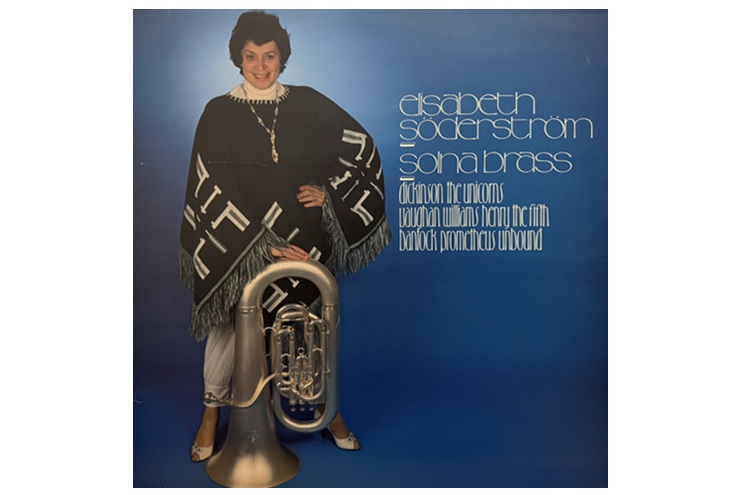
Four of the six short movements feature the Swedish operatic soprano Elisabeth Sӧderstrӧm (1927-2009) who is seen on the front of cover in a fetching poncho behind a frosted Boosey & Hawkes tuba.
Her singing has a tender, melancholic timbre that is first heard after a robust ‘Fanfares and Choruses’ opening as one of the unicorn’s falls asleep to the sweet voice of her ‘Lullaby’ singing. Soon the second is tricked into capture as the dancer acts like a matador in exhausting its spirit.
The finale is a ‘Ballad’ – one of reflection on their desire to live the lives they wish in freedom on the paradise island of St Brendan.
However, their innocence troubled by what they have done, and with their own growing feelings their ‘Love Song’ is interrupted by the sound of celebration as the unicorns are imprisoned. Driven by their distaste for 'modern politics and business exploitation' as described by Dickinson in the sleeve notes, they plan their escape with their magical companions.
The finale is a ‘Ballad’ – one of reflection on their desire to live the lives they wish in freedom on the paradise island of St Brendan.
As the music fades away, you are left to hope they have done just that - “the beasts’ friend and the birds’ friend guarding them on those happy plains”.
Iwan Fox
Play list:
Side 1:
The Unicorns (Peter Dickinson)
1. Fanfares and Choruses
2. Lullaby
3. Dance
4. Interrupted Love Song
5. A Celebration Fugue
6. The Ballad of St. Brendan
Side 2:
1. Henry the Fifth (Ralph Vaughan Williams)
2. Prometheus Unbound (Granville Bantock)