
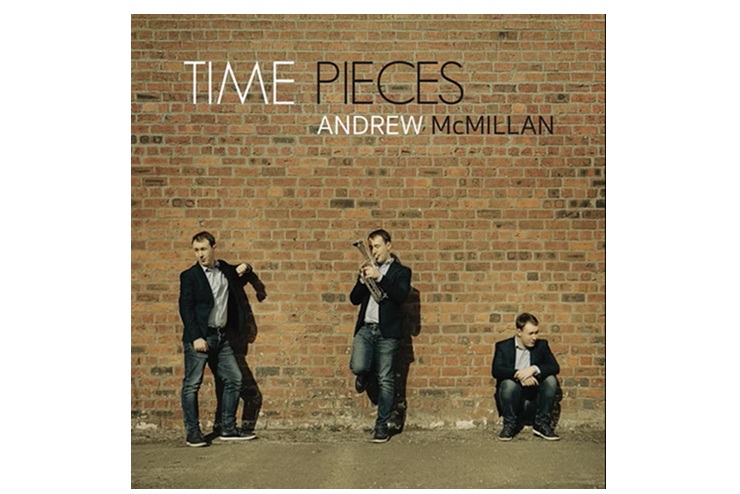
Andrew McMillan
World of Sound Recordings: WOS 181

Tenor horn soloists may well be one of the lesser-known Scottish exports to have made their mark across the globe.
However, whilst Sandy Smith and Sheona White are arguably the most readily recognised, others have also successfully headed south of Hadrian’s Wall in recent years. It will be interesting to see what the future holds then for Andrew McMillan following his graduation as the first BMus tenor horn graduate of the Royal Conservatoire of Scotland.
Explore
He has readily spoken of his desire to explore, both musically as well as personally - aspects displayed by his acclaimed performances in the National Theatre of Scotland’s production of Martin Green’s ‘Keli’, and certainly with this debut release of refreshing ambition.
It makes for a highly engaging series of eight original and arranged works – broaching renaissance and romanticism to hip hop swing and contemporary characterisation.
The decision to use recital accompaniments of small mixed brass, string and percussion ensembles allows the solo voice to be heard with a focused clarity (even muted); one unimpaired by what can otherwise be a suffocating full brass band blanket of sound.
It makes for a highly engaging series of eight original and arranged works – broaching renaissance and romanticism to hip hop swing and contemporary characterisation.
Time travel
The centrepiece is Paul Saggers' title track. A triptych arc of time travel, from renaissance and classical to romanticism, it is styled with informed appreciation and played as such; the opening light footed ‘Estampie’ followed by a ‘Minuet and Trio’ that develops in incremental size and complexity.
The virtuosic flair of the ‘Theme and Variations’ finale take the soloist and listener on an unexpected detour.
A triptych arc of time travel, from renaissance and classical to romanticism, it is styled with informed appreciation and played as such
Surrounding it are tracks that connect in ambition. Andrew Jacob’s ‘Three Bickering Children’ is an increasingly pointed, disjointed series of sibling counter arguments between horn and the twins of the pianist’s hands – the soloist getting the last word.
The argumentative absurdities of Ludovic Neurohr’s ‘Avaritia’ are also pointed with a chaotic acidity that has a deliberate sense of greedy tension, like a glutton finding room to push another morsel of food into the mouth.
Balanced
It’s balanced by the sparse melancholy of Satie’s famous ‘Gymnopodie No. 1’ and Simon Dobson’s sublime ‘Romeo and Juliet’ – a doomed tryst of aching beauty.
Mark Harrison’s arrangement of Bach’s ‘Erbarme Dich, mein Gott’ is a wonderfully realised duet between horn and violinist Soo Yik Lang that flows with shimmering complimentary understanding.
Mark Harrison’s arrangement of Bach’s ‘Erbarme Dich, mein Gott’ is a wonderfully realised duet between horn and violinist Soo Yik Lang that flows with shimmering complimentary understanding.
Elsewhere, Simon Parkin’s ‘Skink’ has a lizardry slyness; a mix of bravura and empty passion in its slippery nod to Bernstein’s ‘West Side Story’ – the startling super G screech calls sounding like sudden outbursts of vicious anger.
‘Korimako’ offers another intriguing detour, built from a minimalist opening that echoes the dawn chorus bell-like sounds of the honeyeater bird, both beautiful but bravura in its self-protection.
Iwan Fox
To purchase: https://www.andrewmcmillan.co.uk/shop
WobPlay: http://www.wobplay.com
Play list:
1. Romeo and Juliet – Star Crossed Summer (Simon Dobson)
2. Erbarme Dich, mein Gott (J.S. Bach arr. Mark Harrison)
3. Time Pieces (Paul Saggers)
i. Estampie
ii. Minuet & Trio
iii. Theme & Variations
6. Gymnopodie No. 1 (Erik Satie arr. Andrew McMillan)
7. Skink (Simon Parkin)
8. Korimako (Chris Gough)
9. Three Bickering Children (Andrew Jacob)
10. Avarita (Ludovic Neurohr)