
Championship Section:
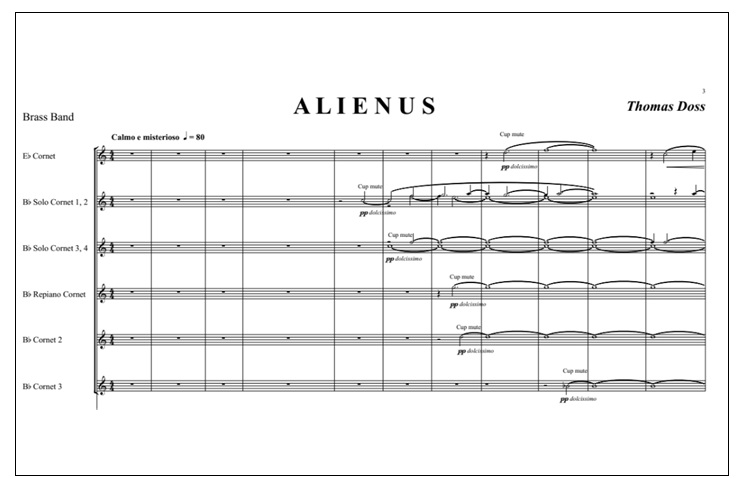
Alienus (Thomas Doss)
In a different life Austrian composer Thomas Doss may well have become a cruciverbalist – and a cryptic one at that.
Many of his major brass band works are structured like crossword puzzles; both vertically and horizontally the opaque clues and hidden meanings found in the lattice-work grids of his scores obfuscate what you might think are the clear answers needed to solve their performance problems.
Torquemada
The inventor of the cryptic crossword called himself Torquemada for a reason. And whilst Doss is not alone in testing the understanding of the literal or figurative, verbatim or vague, not many stretch the technical and musical abilities of players and conductors so willingly by shackling them to his personal version of an inquisition performance rack.
He then deploys all the exotic tools of his trade; ciphers and misdirection, reversals and inversions, addendums and omission, substitutions and stylish dead ends
He then deploys all the exotic tools of his trade; ciphers and misdirection, reversals and inversions, addendums and omission, substitutions and stylish dead ends (who else gives you 20 seconds of bonkers Euro-pop rock for no other purpose than to put a smile on the face) all threaded into the densely layered fodder of the music that hides the essential truth of his matter.
Musical homographs are even found in the signature references to classical music inspiration. His imaginative constructs are like M.C Escher drawings that trick the aural senses. The reality is that the more exciting and strident it all feels, the further away from the truth of the music you become.
McGuffin
‘Alienus’ does just that – the title a form of McGuffin plot device that he states derives from a word “that means more than just extraterrestrial.”
Aliens then?
Perhaps, but not quite in the literal sense of ET and his chums wanting to probe you for information, even if Doss does create a narrative back story in his foreword that would tickle the X-Files fancy of Mulder and Scully. More pertinently he says that “each listener is invited to imagine their own story - or simply to be carried away by the music.”
More pertinently he says that “each listener is invited to imagine their own story - or simply to be carried away by the music.”
‘Alienus’ certainly does that, although a more meaningful clue comes in the link to the hymn ‘Wachetauf, ruftunsdie Stimme’ (‘Sleepers Wake, a Voice is Calling’), written in 1599 by Philipp Nicolai and later immortalized by Johann Sebastian Bach (a favourite cryptic Doss source) in his famous cantata.
It’s based on the New Testament parable of the wise and foolish virgins, and the benefits of apocryphal chastity as extolled by a stranger called Eubulius who describes it all as being “supernaturally great, wonderful and glorious.”
Doss says it “speaks of the foreign, the unfamiliar, the strange. Of that which comes from beyond –and yet stirs questions deep within ourselves.”
Doss says it “speaks of the foreign, the unfamiliar, the strange. Of that which comes from beyond –and yet stirs questions deep within ourselves.”
Not to be saved from ET then, but by the coming of Christ and to those who prepare.
Dig deep
Players and conductors will certainly have had to do their homework and practice to be ready to dig deep to meet all its demands.
Those familiar with works going back to ‘Spiriti’ (written for the European Championships here in 2010 and itself with a bit of Bach ‘supernatural’ Biblical inspiration) will recognise the familiar form and function of what follows and, which has been repeated with other works such as ‘REM-Scapes’, ‘Exstase’, ‘Trance’ etc.
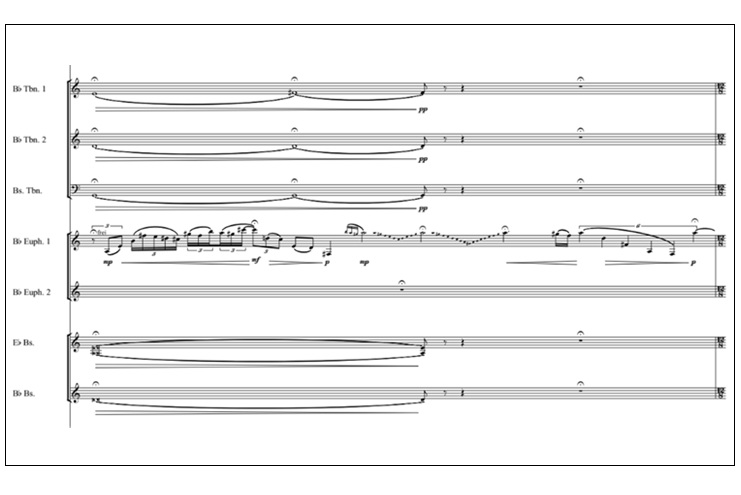
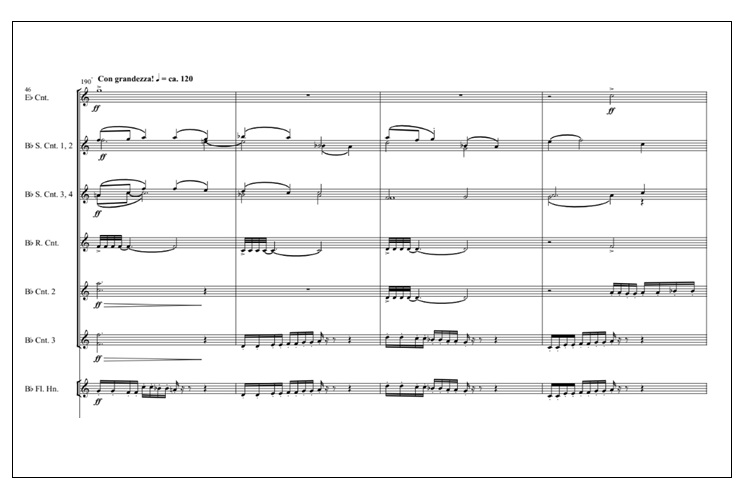
The familiar sounds of ‘Wachetauf, ruftunsdie Stimme’ threads through the score, referenced directly as well as obliquely, enhanced then deconstructed, mirrored and echoed as the complexities of the densely layered internal dynamic balances try to cover the true purpose of the composer’s intention with it until the very end.
Demands
The demands on lead lines are extensive but not from another plane of reality so to speak, and it is good to hear features for what can been seen as secondary solo instruments, whilst the percussion writing is flamboyant but telling – the timps in particular.
Signature Doss moments abound – the quiet, other worldly opening, embedded harmonic movement above which semi quaver work bubbles away, the yearning trombones and cross patterns rhythms
Signature Doss moments abound – the quiet, other worldly opening and embedded harmonic movements above which semi quaver work bubbles away. The yearning trombones and cross pattern rhythms seem to tell you where to look and listen, but are invariably a musical sleight of hand, a conjurer’s trick of misdirection.
All is revealed
Only when the conductor gets the focus right is all revealed - clever and cultured, dense as well as sparse, colourful and monochrome in balance, dynamic and pacing.
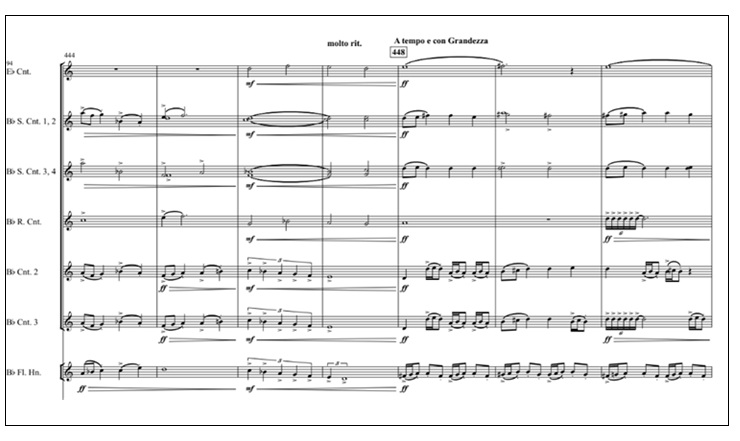
Doss knows how to turn it on when he needs to for effect as well as meaningful musicality, drawing inspiration and energy to a splendid, elongated closing section.
Finally the chorale provides the answers in their full glory in two different time signatures and mulitple derivations of the main tune, “evoking the reverberation of a vast, sacred space” – or in this case the huge contesting expanse of the Brucknerhaus auditorium.
Iwan Fox
Challenge Section:
The Sleepwalkers (Andreas Ziegelback)
On August 3rd, on the eve of Britain’s entry into the First World War, Foreign Secretary Sir Edward Grey, sat at his desk in the foggy gloom of a dark London night, remarked that, “The lamps are going out all over Europe, we shall not see them lit again in our life-time.”
Some four years later with over 20 million dead, he may have reflected further on that moment with regret, for according to Australian historian Christopher Clark in his 2012 book, ‘The Sleepwalkers’ he was one of the politicians who allowed Europe to stumble into the catastrophe.
Martial influences
At the same time Austrian composer Alban Berg completed his ‘Three Orchestral Pieces’ which as a result of the conflict had to await its world premiere until 1923. It’s marital influences and sense of increasing tension now seem like a portent of Berg’s understanding of what he felt was to come.
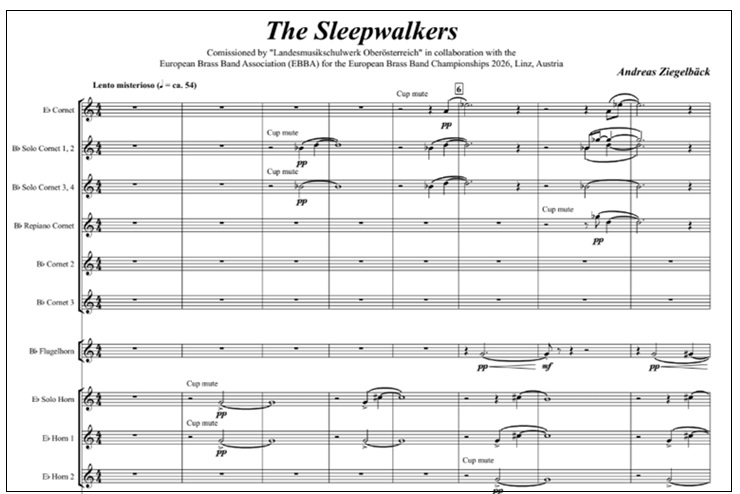
Ziegelback brings these elements together for his work - the opening, mysterious and foggy as if the music itself is being drawn into conflict to follow.
The intensity grows in its militaristic feel, resolute and optimistic as if it will end soon enough, before the reality of mud of Passchendaele brings an end to hope, even if the compulsive, explosive drive remains.
The intensity grows in its militaristic feel, resolute and optimistic as if it will end soon enough, before the reality of mud of Passchendaele brings an end to hope, even if the compulsive, explosive drive remains.
Reflection comes in the central section with connection the sound canvas Mahleresque expression, before the music builds to a sustained climax and a ferocious ending, forceful and agitated – a rimshot one of the final sounds of the battlefields.
Iwan Fox
Andreas Ziegelback was born 1997 in Wels. As composer and conductor, he specializes in wind and brass band music and studied under Thomas Doss at the Mozarteum University Salzburg.
He completed his master’s degree at the Bern University of the Arts where he specialised in band conducting with other studies in composition under Oliver Waespi. He has won several international composition and conducting competitions and since 2025 has been teaching conducting at the Gustav Mahler Private University in Klagenfurt.
European Youth Band Championships
Premier Section:
Burn the Church! (Otto M. Schwarz)
‘Burn the Church!’ reflects on one of the first battles to have taken place in what is now referred to by historians as the ‘Eighty Year’s War’ or ‘Dutch Revolt’ which lasted between 1568 and 1648.
The causes were religious reform, taxation, government centralisation and the rights of Dutch nobility, which in December 1566 kicked off in the French town of Wattrelos, then part of Spanish-ruled Flanders.
Refuge
Protestants in a Calvinist rebel army (sometime referred to as Geuzen), and labelled “the wretched,” were being oppressed by troops under Philip Noircarmes. Seeking refuge, they entered a local church but were soon ambushed. The church was set on fire, many lost their lives, while others escaped only with local support. The annual Berlouffes festival in still commemorates the atrocity.
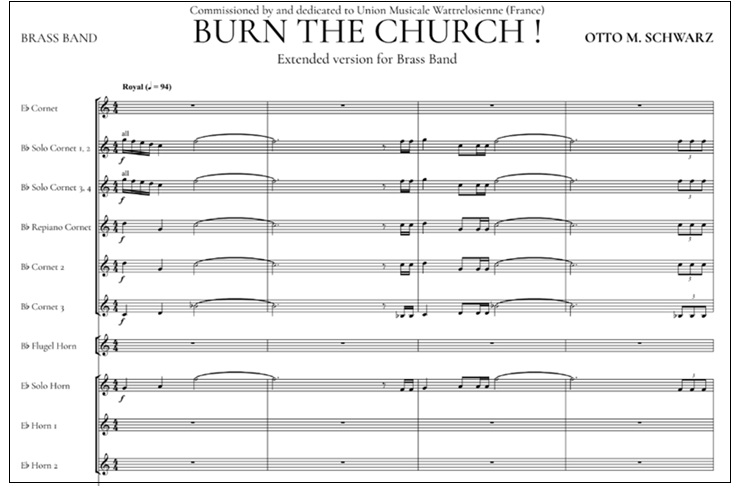
Otto M. Schwarz draw a vivid, and hugely demanding narrative picture of the night, uncompromising and brutal in outlook in what is an extended version of the original wind band work written for and dedicated to Union Musicale Wattrelosienne.
It opens in royal splendour and certainty before a moment of calm heralds the start of frantic skirmishes interspersed with moments of battle fatigue, rest, but ever-present danger.
The military feel remains - whispers and unearthly sounds draw the music forward to its denouement as two forces, one at rest the other closing in on its target.
The military feel remains - whispers and unearthly sounds draw the music forward to its denouement as two forces, one at rest the other closing in on its target.
The aftermath is played out in sombre reflection with freely interpreted solo lines, the final section an amalgam of triumphalism or tragedy depending on what side loyalties lie.
Iwan Fox
Otto M. Schwarz was born and lives in Wimpassing, south of Vienna. He started to compose as a teenager and studied trumpet and composing in Vienna. His earliest success came through pop music where he remains very active as a producer.
Since 2001, he has focused preliminary on music for film and TV productions, but is also a leading composer of music for wind bands with popular works such as ‘Nostrodamus’ and ‘Fire and Ice’ which display his trademark ability to combine energetic rhythms, emotional depth and colourful orchestrations.
Development Section:
Meet the Giants (Thomas Murauer)
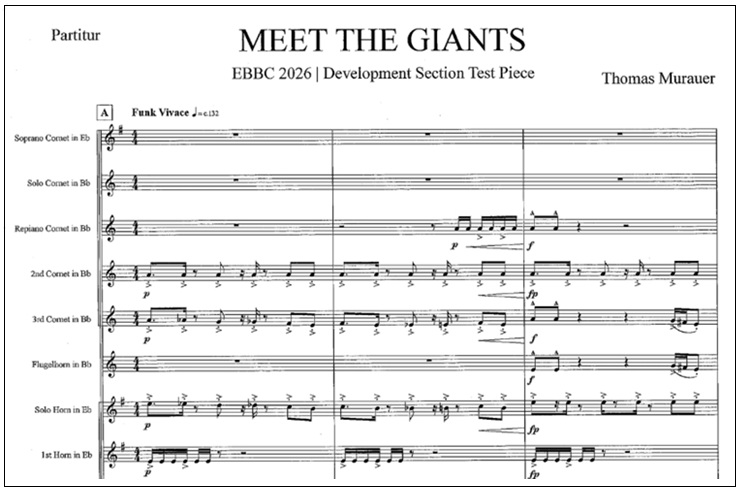
Murauer’s neatly constructed, technically ambitious composition packs plenty of homage into its six and half minute duration.
Essentially, it’s a musical journey in time to meet composers who, according to him, “shaped our musical world”.
Vivaldi, Beethoven and Chopin and to a lesser extent, Rachmaninoff, were “architects of entire universes”, blessed by a vision and inner spark of creativity that persistently whispered, “There is more. Keep going”.
Centuries of span
This is the inspiration for a work which acts as a bridge that spans centuries (there is over 200 years between their deaths) and styles to connect to a new generation of youthful performer and listeners. It’s a bit like drum and bass Beethoven being played out in Westminster Abbey.
It’s a bit like drum and bass Beethoven being played out in Westminster Abbey.
The five linked sections open with ‘Vivaldi & Winter’ in referencing the cold, biting chatter and articulation of the composer’s most famous work. ‘Baroque meet Funk’ sees motorics translated into a modern backbeat drive, whilst ‘Homage to Beethoven’ is full of intensity, drama and deafening (appropriate enough) climax.
The calm that follows depicts the elegant beauty of Chopin and the romanticism of Rachmaninoff (who plays a slightly minor role to the giants), before the music comes full circle and a fast funk finale.
Iwan Fox
Trumpet player Thomas Murauer is a composer and arranger who specialises in what he calls, “capturing the essence of a moment,” creating evocative scores for film, television, radio, and diverse ensemble formats.
His musical vision extends into marketing although he views both disciplines through the same lens; whether designing a brand strategy or a musical score, he is says “the mission is identical - to move people, touch hearts, and tell stories that resonate long after the final note”.